

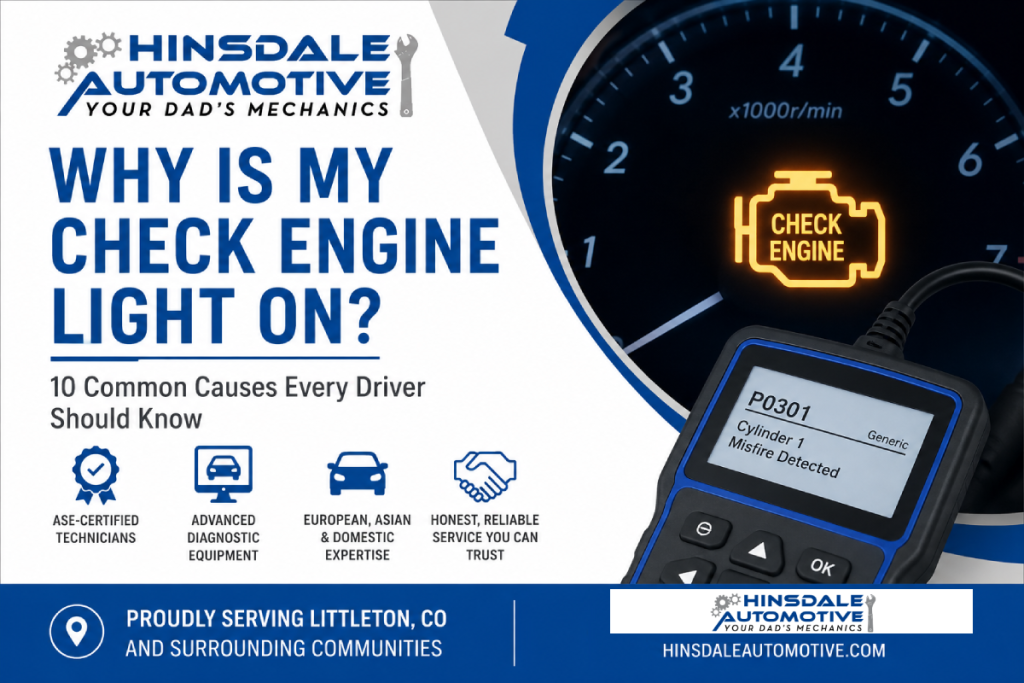
When your engine warning light suddenly appears on your dashboard, it can be frustrating and confusing. Many drivers immediately ask the same question: Why is my check engine light on? While the warning light can signal a wide range of issues, it’s designed to alert you when your vehicle’s onboard diagnostic system detects a problem affecting performance, efficiency, or emissions.
Modern vehicles are equipped with advanced monitoring systems that constantly track engine performance, fuel efficiency, and emissions. When something falls outside of the normal range, the system triggers the check engine light.
Because the light can indicate anything from a simple fix to a more complex issue, the best step is always a professional check engine light diagnosis.
At Hinsdale Automotive, drivers throughout the Littleton, CO area rely on our experienced team to accurately diagnose and repair engine warning light issues for European, Asian, and domestic vehicles.
Below are some of the 10 most common check engine light causes drivers encounter.
1. Loose or Damaged Gas Cap
One of the simplest and most common reasons your engine warning light turns on is a loose, damaged, or missing gas cap.
Your vehicle’s gas cap plays an important role in maintaining pressure within the fuel system and preventing fuel vapors from escaping into the atmosphere.
Signs the Gas Cap May Be the Issue
- The light appears shortly after refueling
- The cap feels loose when you check it
- The cap seal appears cracked or worn
2. Faulty Oxygen Sensor
The oxygen sensor is responsible for monitoring the amount of oxygen in your vehicle’s exhaust gases. This information helps the engine control unit maintain the proper air-to-fuel ratio for efficient combustion.
When the oxygen sensor fails, the engine may run too rich (too much fuel) or too lean (too much air).
Common Symptoms of a Bad Oxygen Sensor
- Decreased fuel efficiency
- Rough engine performance
- Increased exhaust emissions
- Check engine light remains illuminated
Because oxygen sensors play a critical role in engine performance and emissions control, replacing a faulty sensor promptly helps prevent further damage to other components, such as the catalytic converter.
3. Failing Catalytic Converter
The catalytic converter is part of your vehicle’s emissions system. Its job is to convert harmful exhaust gases into less harmful substances before they leave the exhaust system.
Symptoms of Catalytic Converter Problems
- Poor acceleration
- Reduced engine performance
- Dark exhaust smoke
- Strong sulfur or “rotten egg” smell from exhaust
Catalytic converter issues are often the result of other underlying problems, such as engine misfires or faulty sensors.
4. Worn or Failing Spark Plugs and Ignition Coils
Spark plugs and ignition coils work together to ignite the air-fuel mixture inside your engine’s cylinders. Over time, these components wear out and may cause engine misfires.
When misfires occur, the vehicle’s onboard computer detects the irregular combustion and triggers the engine warning light.
Signs of Ignition System Problems
- Engine misfires
- Rough idling
- Reduced engine power
- Difficulty starting the vehicle
Ignoring ignition system problems can lead to additional engine issues.
5. Mass Air Flow (MAF) Sensor Problems
The mass air flow sensor measures the amount of air entering the engine so the engine control unit can deliver the correct amount of fuel. If the sensor becomes dirty or fails, the engine may struggle to maintain the proper air-fuel ratio.
Symptoms of a Failing MAF Sensor
- Engine hesitation or stalling
- Poor acceleration
- Rough idling
- Reduced fuel efficiency
Because the MAF sensor plays a key role in fuel delivery and engine performance, it’s important to have the issue diagnosed by an expert mechanic.
6. Vacuum Leak in the Engine
Your engine relies on a complex system of vacuum hoses to regulate airflow and fuel delivery. Over time, these hoses can crack, become loose, or deteriorate due to heat and age.
Symptoms of a Vacuum Leak
- Rough idle
- Hissing noise from the engine bay
- Engine stalling
- Reduced engine performance
7. Faulty EGR Valve
The Exhaust Gas Recirculation (EGR) valve helps reduce harmful emissions by recirculating a portion of exhaust gases back into the engine. This lowers combustion temperatures and helps minimize nitrogen oxide emissions.
Signs of EGR Valve Issues
- Engine knocking
- Rough engine performance
- Decreased fuel efficiency
- Increased emissions
A malfunctioning EGR valve can affect engine performance and emissions compliance.
8. Evaporative Emissions (EVAP) System Issues
The EVAP system captures and stores fuel vapors from the fuel tank so they don’t escape into the atmosphere. These vapors are later redirected into the engine to be burned during combustion.
Leaks or failures within the EVAP system can trigger the check engine light.
Common EVAP System Problems
- Damaged hoses
- Faulty purge valve
- Leaking charcoal canister
- Loose or faulty gas cap
Because EVAP leaks can be very small and difficult to locate, specialized diagnostic equipment is often required to identify the issue accurately.
9. Failing Engine Sensors
Modern vehicles rely on numerous sensors to monitor engine performance. These sensors send data to the engine control unit so it can adjust fuel delivery, ignition timing, and emissions systems.
Examples of Engine Sensors That May Trigger the Check Engine Light
- Crankshaft position sensor
- Camshaft position sensor
- Throttle position sensor
- Engine coolant temperature sensor
10. Battery or Charging System Issues
Although the check engine light is typically associated with engine performance problems, electrical issues can also trigger it.
Your vehicle’s battery, alternator, and charging system supply power to the onboard computer and sensors. If voltage levels become unstable, the system may activate warning lights.
Signs of Charging System Problems
- Dim headlights
- Difficulty starting the vehicle
- Flickering dashboard lights
- Multiple warning lights appearing at once
Electrical problems can affect multiple vehicle systems simultaneously, making professional diagnostics especially important.
Why Professional Check Engine Light Diagnostics Matter
When drivers search for answers to what triggers a check engine light, they often discover that dozens of different components can activate the warning system.
A professional check engine light diagnostic service uses advanced scanning tools to read diagnostic trouble codes stored in the vehicle’s computer. These codes provide valuable clues that help technicians pinpoint the exact source of the issue.
Working with an experienced mechanic ensures that the correct repairs are made the first time, preventing unnecessary parts replacement and helping maintain your vehicle’s performance and reliability.
At a trusted professional automotive repair shop, like Hinsdale Automotive, technicians combine diagnostic technology with hands-on experience to accurately identify engine problems and restore your vehicle to proper operating condition.
Why Drivers in Littleton Trust Hinsdale Automotive
For drivers in Littleton, CO, and surrounding communities, including Highlands Ranch, Denver, Centennial, and Lakewood, Hinsdale Automotive has built a reputation for dependable automotive care.
As a family-owned and operated auto repair shop, Hinsdale Automotive has proudly served the Denver suburbs since 2009. Our team of skilled technicians is ASE-certified and TechNet-certified, ensuring your vehicle receives professional-level service and attention.
Whether your vehicle is European, Asian, or domestic, our technicians are trained to perform accurate check engine light diagnosis using advanced diagnostic equipment.
Drivers choose Hinsdale Automotive because we offer:
- Experienced ASE-certified technicians
- Advanced diagnostic technology
- Comprehensive automotive repair services
- Expertise with a wide range of vehicle makes and models
- Friendly, honest service from a trusted local team
Conclusion: Don’t Ignore a Check Engine Light—Get a Professional Diagnostic
From a loose gas cap to sensor failures or emissions system issues, there are many common reasons the check engine light comes on. While some problems may seem minor at first, they can lead to more serious performance issues if left unresolved.
The safest and most effective solution is to schedule a professional check engine light diagnostic service with a qualified technician. An expert mechanic can identify the exact cause of the warning and ensure your vehicle receives the appropriate repair.
If your engine warning light is on and you’re in the Littleton, CO area, the experienced team at Hinsdale Automotive is here to help.
Our professional automotive repair shop proudly serves drivers throughout Littleton and nearby communities, delivering reliable diagnostics and trusted auto repair services to keep your vehicle running smoothly.
Contact us at (303) 617-0152 or reach our Facebook page.
Frequently Asked Questions
Why is my check engine light on?
Your check engine light turns on when the vehicle’s onboard diagnostic system detects an issue affecting the engine, emissions, fuel system, or related components. Common causes include a loose gas cap, a faulty oxygen sensor, misfires, EVAP leaks, or sensor problems.
Can a loose gas cap cause the check engine light to come on?
Yes. A loose, damaged, or missing gas cap can allow fuel vapors to escape and disrupt fuel-system pressure, causing the vehicle’s computer to activate the check engine light.
Is it safe to drive with the check engine light on?
A steady check engine light may indicate a problem that requires prompt diagnosis, while a flashing light can signal a serious issue such as an active engine misfire. A flashing light should be addressed immediately to help prevent further damage.
Can bad spark plugs trigger a check engine light?
Yes. Worn spark plugs or failing ignition coils can cause engine misfires. The onboard computer detects these combustion problems and may turn on the check engine light.
How is a check engine light diagnosed?
A technician uses diagnostic scanning equipment to retrieve trouble codes from the vehicle’s computer. The codes provide clues about the affected system, which the technician combines with further testing to identify the underlying problem.
Where can I get a check engine light diagnosis in Littleton, CO?
Drivers in Littleton and surrounding communities can visit Hinsdale Automotive for professional check engine light diagnosis. Its technicians service European, Asian, and domestic vehicles using advanced diagnostic equipment.


